
If there is one area where we encourage clients to spend a little extra money, it is the systems that control heat and moisture. Louisiana humidity is brutal. A home in the Gulf South has to manage both temperature and moisture, and a system that only does one well will leave you uncomfortable, or worse, dealing with mold.
Most of South Louisiana falls in a hot-humid climate zone, where outdoor moisture levels stay high for much of the year. The way your HVAC system, insulation, and building envelope work together determines whether your home feels crisp and comfortable or cold and clammy.
Key Takeaways
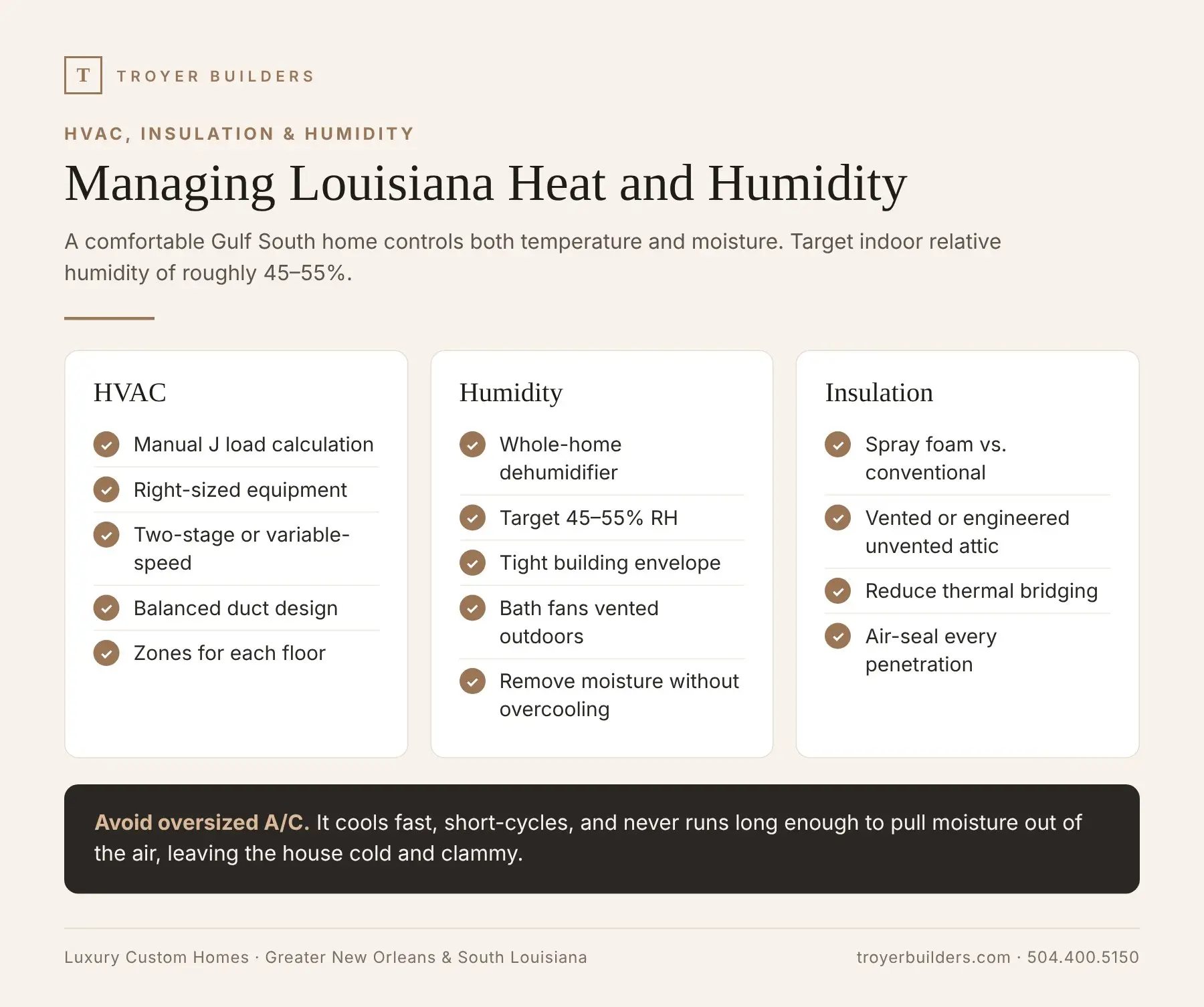
- Always have a Manual J load calculation performed and size the HVAC system to it.
- Avoid oversized air conditioning. It short-cycles and fails to remove enough moisture.
- Consider two-stage or variable-speed equipment, balanced ductwork, and separate zones for each floor.
- Target indoor relative humidity around 45–55%, often with a whole-home dehumidifier.
- Seal the building envelope, vent bathrooms outdoors, and choose insulation and attic strategies carefully.
HVAC: Right-Sized, Not Oversized
- Have a Manual J load calculation performed. This room-by-room calculation accounts for windows, insulation, orientation, and air tightness to determine the actual heating and cooling load.
- Properly size the HVAC system. Equipment should be selected to match the calculated load, not a rule of thumb like “one ton per 500 square feet.”
- Consider two-stage or variable-speed equipment. These systems run longer at lower output, which improves comfort and moisture removal.
- Design ductwork for balanced airflow so every room gets the air it needs, with proper returns.
- Consider separate zones for different floors. Upstairs rooms in Louisiana heat up quickly; independent zones keep each level comfortable.
Why oversized A/C is a problem
An oversized system cools the house quickly, then shuts off before it has run long enough to pull moisture out of the air. The thermostat is satisfied, but the humidity stays high. The result is a home that feels cold and damp at the same time, with a higher risk of condensation and mold. Bigger is not better.
Humidity: The Other Half of Comfort
- Consider a whole-home dehumidifier integrated with the HVAC system, especially for tight, energy-efficient homes.
- Target indoor relative humidity around 45–55%. This range is comfortable and helps discourage mold and dust mites.
- Properly seal the building envelope so humid outdoor air is not constantly leaking in.
- Ensure bathrooms exhaust outdoors, not into the attic.
- Make sure the system can remove moisture without excessively cooling the house, particularly in spring and fall when temperatures are mild but humidity is high.
Humidity control is also a core part of mold prevention, and it is built into how we approach every custom-engineered smart home.

Insulation and the Building Envelope
- Evaluate spray foam versus conventional insulation. Spray foam provides insulation and air sealing in one step; conventional insulation can perform well when paired with meticulous air sealing.
- Pay attention to attic ventilation or an engineered unvented attic. Bringing ductwork inside a conditioned, unvented attic can significantly reduce energy loss in hot climates, but it must be designed correctly.
- Address thermal bridging where framing members conduct heat through the wall.
- Air-seal penetrations around plumbing, electrical, and HVAC. Small gaps add up to big leaks.
How Troyer Builders Approaches Comfort
We treat the HVAC system, insulation, windows, and envelope as one integrated design, not separate line items. That coordination is one of the biggest advantages of our design-build process: the people designing the house and the people selecting the systems are working from the same plan.
Frequently Asked Questions
What humidity level should a Louisiana home have?
Aim for roughly 45–55% relative humidity indoors. Higher levels feel muggy and encourage mold; much lower levels can feel dry.
Do I need a whole-home dehumidifier in Louisiana?
Not every home needs one, but they are very helpful in tight, energy-efficient homes and during mild, humid seasons when the A/C does not run long enough to dry the air.
Is spray foam insulation worth it in Louisiana?
It often is, especially for unvented attics with ductwork inside the conditioned space. The right choice depends on your design and should be part of an overall envelope strategy.
Related Reading
- Hurricane-Resistant Roofing for Louisiana Homes: Roof Design, Straps, and Wind-Rated Openings
- Custom-Engineered Smart Homes by Troyer Builders: Designed for You, Ready for the Future
- Storm-Ready Luxury Homes: How Troyer Builders Prepares Louisiana Homes for Hurricane Season
- Fully Custom Homes: What It Really Means to Build From Scratch
Build Your Louisiana Custom Home With Troyer Builders
Troyer Builders is an award-winning luxury design-build firm serving Greater New Orleans, Metairie, the Northshore, and South Louisiana. From land evaluation and engineering through architecture, construction, and finishes, we guide every step through our Vision, Design, Create process. Explore our completed homes, meet our team, and see what homeowners say in our Google reviews.
Ready to talk about your project? Call or text us at 504.400.5150, email greg@troyerbuilders.com, or send us a message. Share your lot address, approximate square footage, and the features you have in mind, and we will help you understand what it will take to build.
Troyer Builders | 3117 18th Street, Suite 100, Metairie, LA 70002 | Get directions on Google Maps